Courage to change course
The problem of evil is as ancient as the Fall in Genesis. And alas, human nature has since remained unchanged. Yet, the readings of today shift our focus away from good and evil in abstract terms to looking at its practical aspects: our personal responsibility and our capacity for conversion.
In the First Reading (Ezek 18:25-28), the Jews in Babylonian exile look for someone to blame. That’s typical human psychology. Stripped of their homeland and Temple, they accuse God of being unfair; they feel they are being punished unjustly for the sins of their ancestors rather than for their own actions. God sharply rejects this view, saying: ‘Is it my way that is unfair, or rather, are not your ways unfair?’
That passage of Ezekiel is a foundational Old Testament expression of key spiritual realities: free will, personal responsibility, inner conversion, the risk of complacency, and the absolute need for God’s grace. That is to say, God looks for personal accountability, not our ancestors’ sins; we are not defined or trapped by our past failings or even our environment. If the righteous turn away from virtue, they fall; but if the sinner repents and does what is right, they preserve their spiritual life. God’s justice is not a trap but a continual invitation to change course.
This capacity to turn around requires a surrender of ego, as St Paul illuminates in the Second Reading (Phil 2:1-11). In what is one of the most beautiful Christological hymns – Carmen Christi, a Latin phrase that translates literally to ‘Song of Christ’ or ‘Hymn to Christ’ – in the New Testament, the Apostle exhorts us to give up selfishness and boastfulness, adopting instead the attitude of Jesus. Christ was divine, yet emptied Himself (kenosis), not of his divine nature but of the earthly manifestation of His glory. He took the form of a servant and became obedient even unto death on a cross. Thus, humility is key; it unlocks us from our sinful patterns.
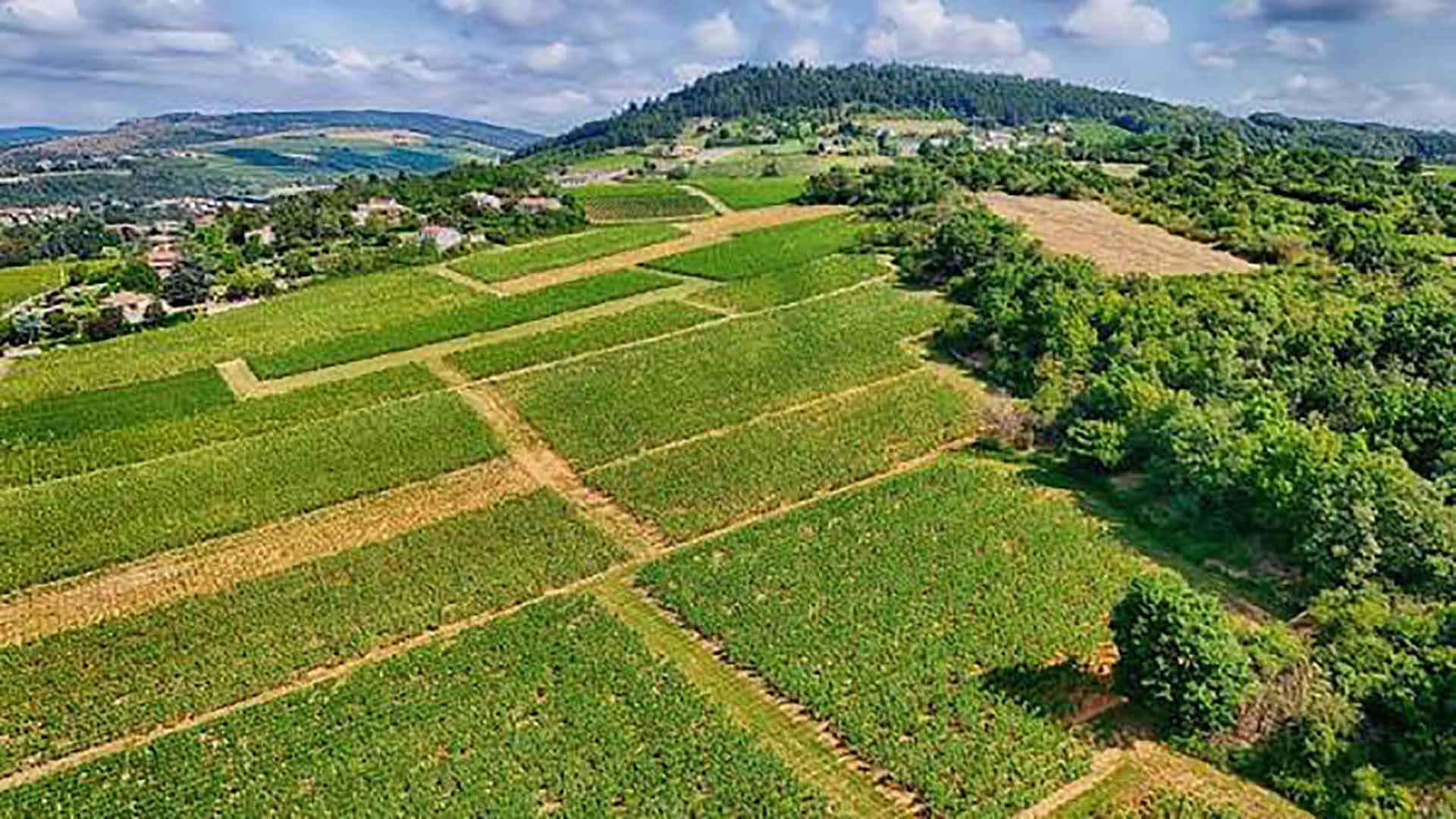
Finally, the Gospel (Mt 21:28-32) puts human psychology at the centre of the story through the Parable of the Two Sons. When asked to work in the vineyard, the first son initially refuses, but later, feeling sorry, he goes. The second son politely says, ‘Yes, sir,’ but does nothing. Jesus uses this to pierce the complacency of religious authorities. The chief priests and elders are like the second son – professing righteousness but remaining unmoved by the predicament of others. Meanwhile, the marginalised tax collectors and prostitutes, who initially walked away from God, repented at the preaching of John the Baptist and entered the Kingdom of God first.
The core message of today’s liturgy of the Word, therefore, is that God is not tyrannical but just and merciful. He cares less about a flawless start and far more about a faithful finish. God challenges our defence mechanisms and calls us to humbly change our behaviour rather than just our words. True obedience is not found in pious promises but in the ongoing decision to change our lives for the better.

Goencheo Mhonn’neo | Adágios Goeses - XVII
Segue a décima-sétima lista de adágios,[1] extraídos do livro Enfiada de Anexins Goeses, obra bilíngue (concani-português), de Roque Bernardo Barreto Miranda (1872-1935)[2].
| Concani | Tradução literal | Tradução livre
|
| Sezarealó combó sodanche motto.
Sezarealo kombo sodanch motto.
Reddé, paddé zogortay, zaddanchêr kal. Redde, padde zogoddtai, zaddancher kal.
Ar veta mhunn gãindev votçunk lagló, chirddunn meló. Har veta mhunn gaindoll vochunk laglo, chidd’ddun melo. |
O galo do vizinho
é sempre bem gordinho.
Tendo alguém um objecto nada feio, parece-lhe melhor que o seu, o alheio.
Quando os búfalos e os bois põem-se em briga, às cornadas, as plantas tremem, com medo de ficarem molestadas. Quando há entre os de cima questões ou dissidências, os de baixo é que sofrem pelas suas consequências.
A exemplo da jiboia que passara pela estrada, a minhoca também quis passar, mas morreu pisada.
Quando um remediado imita em tudo um rico, liquida-se, arruinado. |
[1] Cf. décima-sexta lista, Revista da Casa de Goa, Série II, No. 41, julho-agosto de 2026, p. 55.
[2] Roque Bernardo Barreto Miranda, Enfiada de Anexins Goeses, dos mais correntes (Goa: Imprensa Nacional, 1931), com acrescentamento dos adágios na grafia dialectal e moderna, pelo nosso editor associado Óscar de Noronha.
Publicado na Revista da Casa de Goa, Serie II, No. 42, set-out de 2026, p. 53
Abbé Faria: one of Goa’s first global citizens
Link to the original interview in Portuguese on Renascenca Goa podcast https://www.youtube.com/watch?v=wnBCV6fCgTI
ON: September this year [2019] is the month of Abbé Faria, marking two hundred years since his passing… Let’s start by talking about your interest in Abbé Faria…
ISRV: I have such great respect for Abbé Faria that I believe every year is a year dedicated to Abbé Faria. His contribution, in so many ways, is something we must not forget, and I am delighted that you have taken an interest in this figure, this subject and this date.
The person who first planted the seed in my mind to undertake a slightly more in-depth study of Abbé Faria was Mr Matanhy Saldanha. He invited a few people round for tea and discussed whether it might be possible to do something — let’s say, a small museum or some other activity — to honour the great figure of Abbé Faria. At that time, Mr Matanhy Saldanha was a member of the Government, but a few months later he was no longer in government, and the whole project fell through.
But I didn’t lose interest. I’d already started reading up on it, and at that point I discovered that, many years earlier, my brother, Luís, had written an article. When I read that article, I became even more interested, and both Luís and I continued to do a bit of research. He did far more than I did, but I made use of the information he’d gathered to carry out some work of my own later on.
That’s when my interest really took off. But we found more and more information, and more and more people who had, in one way or another, been in contact with Abbé Faria, so it turned into a truly fascinating journey.
FILM ON FARIA
ON: How did you take this interest further? Did you make a film?
ISRV: Yes, I took part in a short course in film-making or video-making. And when we reached the end of the course, each of us had to decide on a project, based on how we would have made a film. When one of my classmates, Cecil Pinto, and I began to delve deeper into our interest in Abbé Faria, we thought, why not make this documentary?
By that point, I already had plenty of material, so the idea for a documentary emerged, and we decided that, since there were people around us who had the relevant knowledge, the film should be interview-based…
ON: To prepare for this documentary, In Search of Abbé Faria https://www.youtube.com/watch?v=2mdL24UOXVs, can you tell us which authors you read and the people you spoke to, because, nowadays, finding people who know about Abbé Faria’s life must be quite rare…
ISRV: The Central Library was a very rewarding place for me because I was able to read what Egas Moniz says about Abbé Faria, what Gelásio Dalgado says about Abbé Faria, and a whole host of newspaper articles… Gomes Catão and various other people who wrote about Abbé Faria… It’s all on record…
ON: I hope we’ll now take an interest in the information you have provided, given that the Library is really very well organised…
ISRV: Very well organised indeed, and with such a rich collection… And if anyone shows an interest in reading something, they help — they really do help — and it was easier because my brother Luís had already looked into several of these authors, so I knew where to go and what to read…
RESEARCH ON FARIA
ON: You already had some leads… But when you spoke to people, did you find anything new, or was it just a repeat of what was in the books?
ISRV: We found two people. We knew these people existed, but we got in direct contact with them: one was the Russian Professor, Mikhail Buyanov. We sent him an email and he replied. He wasn’t very fluent in English, but he replied through a colleague. And we’d already read the chapter in his book Psychiatry and You.
We also contacted a lady, an Italian teacher, who has written several books on Portuguese theatre. She was an Italian, no doubt, but Portuguese at heart, so to speak. She told us things that really made our trip even more interesting… She told us that both she and her husband had collected a great deal of material on Abbé Faria. She was unable to share it with us because, meanwhile, she passed away: Luciana Stegnano Picchio.
So, for those in Italy, it’s quite possible they’ll get more material. And I’m sure there must be more newspapers in France, as well as other records in churches and various other places, and scholars too – perhaps more recent ones…
ON: And in Goa?
ISRV: Here in Goa, we’d already contacted people. We already had an idea of what they knew, but sometimes we came across additional information. For example, Dr Manohar Sardessai. Certain things he said stuck in my mind. The story that the Abbé was supposedly imprisoned at the Château d’If: it’s not history, it’s perhaps a legend.
But what Professor Sardessai said was that here in India, legend is more important than history, and that history does not become reality until it turns into a legend... So, if we think of it in this way, Abbé Faria is as much history as he is legend…
ON: That is why Abbé Faria continues to live on… Did you find any of Faria’s relatives?
ISRV: We were very lucky to find Mr William Faria in Candolim – a great-grandnephew, I believe. We visited Mr Faria and when the film was screened in Panjim, he attended… He was already over 80 years old.
I’d also like to mention that we visited Abbé Faria’s house in Colvale. It was already in ruins by then, but there was a sign that read ‘Solar dos Farias’ (Faria Mansion). It was a beautiful house, though in ruins, and in such a lovely spot overlooking the river and the beach…
ON: Is it the same one with a chapel nearby? Doesn’t it belong to José Nicolau da Fonseca?... It isn’t Abbé Faria’s original house, is it?
ISRV: I think part of it was original and was rebuilt, and now even the part that was rebuilt is completely in ruins…
ON: Well, the people you spoke to must have said something new. Do you remember anything?
ISRV: There are certain things that were said which we can’t really confirm. For example, Professor Mikhail Buyanov spoke of the chess set that was enlarged by Abbé Faria: these things are unheard of in Goa. Perhaps it’s true, perhaps it isn’t, but it’s also an interesting legend…
ON: Did Buyanov ever visit Goa?
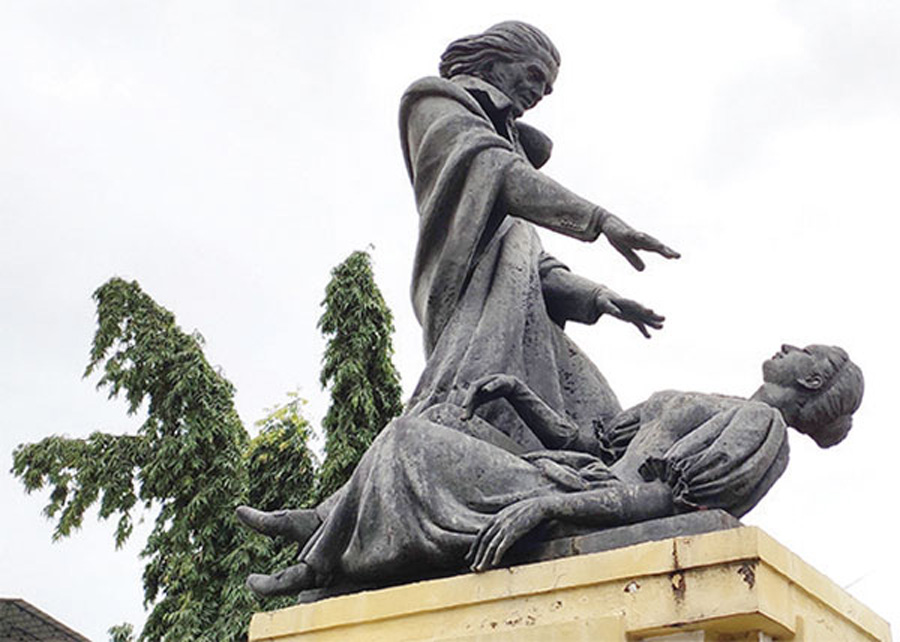
ISRV: Yes, he did, and we have a photograph of him near the statue of Abbé Faria.
FARIA’S LIFE
ON: Moving on to Abbé Faria’s life. What were the key milestones in the life of José Custódio de Faria?
ISRV: There were various stages in his life, and all of them, I think, left their mark in some way on his heart. For example, his childhood, the years he spent in Goa aged 14 and 15: I think they must have had a significant influence on him.
One person who is forgotten, let’s say, has not been forgotten by me, for in the play I wrote about Abbé Faria titled Kator Re Bhaji, one of the main characters is Catarina, who was José Custódio’s adopted sister. I am convinced that this girl, who was more or less the same age as José Custódio, must have had some influence on his imagination. When he was in Lisbon – and both he and his father had lost touch with Goa — he wrote a single letter to a neighbour in Candolim and sent an oratório (oratory) to his sister Catarina. One wouldn’t send an oratory to someone for whom one has no affection whatsoever. So, for me, that oratory is a symbol of the attachment he felt for Goa.
Furthermore, in the book he wrote [De la cause du sommeil lucide — On the Cause of Lucid Sleep], there are words in Konkani. He speaks of ‘mutt marop’, ‘tel lavop’, which shows that his childhood was not very different from ours in Goa: the same sort of family, the same family care… So, I think his time in Goa was important in his life.
Then there was the journey to Portugal by boat: what a great adventure! In Lisbon, father and son knew the language and had some contacts, but I think Rome must have been even more interesting — for the father, but even more so for the boy — because he was going there to study, and there must have been teachers, libraries, and books there that made him think of a wider world.
He returned to Portugal and I think that marked a third phase, which must have been quite difficult. We’ve spoken of the ‘Kator re bhaji’ that the father said to his son… Was the father referring only to that particular speech, or to the whole of life — the future that lay ahead of this young man — which wasn’t going to be easy?
What’s more, the father soon found himself shut away in his own home, and the boy had to leave for France. He spent a significant part of his life in France, where he was very well known, and then became completely disoriented because people made fun of him. He died utterly destitute and humiliated.
FARIA’S FATE
ON: One thing that strikes me is that this family never met again…
ISRV: I get the impression that the father always wanted to return because, when he arrived in Rome, he tried to buy the typefaces for Malayalam and Tamil. He was a scholar. He had a love for India and a nativist streak, as we say; so, I’m convinced that they intended to return, but the political situation was such that they were never able to…
ON: His gesture towards Catarina reveals the affective side of José Custódio de Faria. Don’t you think this is a side of Abbé Faria that hasn’t received much attention?
ISRV: For me, personally, there are two aspects that have not been explored: one was this, the family aspect, and the second was the spiritual aspect. He was a priest — let us not forget that. The speech he gave and the research he undertook were on the Holy Spirit. I do not think these were superficial matters. When he was studying the human brain and hypnotism, might he not have been thinking about the human spirit? I am certain that he must have pursued that line of thought. It is a very personal certainty, a personal conviction.
Therefore, certain aspects of José Custódio’s spirit were so intimate that not everything was said, and it was in this spirit that I wrote that play…
[Next, Catarina’s song, composed and performed by classical guitarist Rui Lobo for the play Kator Re Bhaji]
ON: In this whole story of Abbé Faria, there is much more to be done in terms of research in archives and libraries, talking to people, and so on, but also in terms of the tribute itself… So, what remains to be done?
ISRV: Professor Matanhy had the idea that the house in Candolim could be turned into a museum without too much difficulty, because the house now belongs to the Provedoria, but it didn’t go ahead. It’s something that can be done now.
Another suggestion we put forward at the time was that the Indian Government could have issued a commemorative stamp. The Portuguese Government produced a first-day cover featuring a bust of Abbé Faria. In India, we have done nothing of the sort. I believe that not only in Goa but throughout India, people need to learn about this figure — perhaps one of our first global citizens.
ON: With these very interesting words from you and your perspective, we thank you for this interview and hope that you will continue to take an interest in Abbé Faria!
ISRV: Thank you!
Isabel de Santa Rita Vás has been a teacher by profession for over three decades, and is now retired; she taught in school, college and is on the guest faculty of Goa University. She is a founder member of the Mustard Seed Art Company, an amateur theatre group that has been performing plays for the last 39 years. She has written a number of plays, often directs them and has written the scripts of a few video-films commemorating interesting Goan personalities like Abbé Faria, Dr José Pereira, and writer Victor Rangel-Ribeiro, all made in collaboration with Cecil Pinto.
First published in Revista da Casa de Goa, Series II, No. 42, Sep-Oct 2026, pp 68-72
A Whole Life in Christ
One of the most profound truths of Scripture is that ‘man does not live by bread alone, but by every word that comes forth from the mouth of God.’ This was originally said by Moses to the Israelites (Deut 8:3) to remind them that God sustained them with manna in the wilderness. Jesus famously quoted it (Mt 4:4) to defeat temptation, emphasising that, like physical food, spiritual food is indispensable.
Today’s readings turn the spotlight on just that — physical food — but the final thrust is on the spiritual nourishment. In the First Reading (Is 55:1-3), the Lord calls us who are thirsty to come to the water; those who have no money, to come and receive grain, drink wine and milk — all of it for free. But He does not stop there. He comments on earthly food, saying ‘Why spend your money for what is not bread; your wages for what fails to satisfy?’
Very much so. The bread we eat lets us live; but to live eternally, only what comes from God’s hand can help. Hence, an early church tradition about organised charity says that material relief should be dispensed through the parish structure, where recipients could simultaneously receive spiritual instruction: food for the body and for the soul, hand in hand.
A question that strikes us about the Gospel (Mt 14:13-21) is: why did Jesus withdraw to a deserted place when He heard of the death of John the Baptist? Was it an act of cowardice or of indifference? He was turning away from the noise of the public, to grieve and to pray to the Father for strength to align His human will with the unfolding Paschal Mystery. It was not an act of prudence or cowardice to avoid a premature confrontation with Herod.
The Evangelist does not speak of any protest or even a mere murmur of discontent. The crowds went about their daily chores. We could say they forgot everything else and set their eyes on the Lord – the Bread of Life and the Living Water – who is gracious, merciful, kind, compassionate, just, and truthful, was moved with pity for them. He did not insist they looked heavenward but promptly satisfied their immediate need: physical hunger.
While the disciples wanted Jesus to dismiss the crowds and have them go find food for themselves, Jesus said: ‘There is no need for them to go away; give them some food yourselves.’ Jesus taught them that when God is with us, there is nothing we can want. Just as He partakes of our joys and sorrows, we must show concern and exercise charity in everyday life.
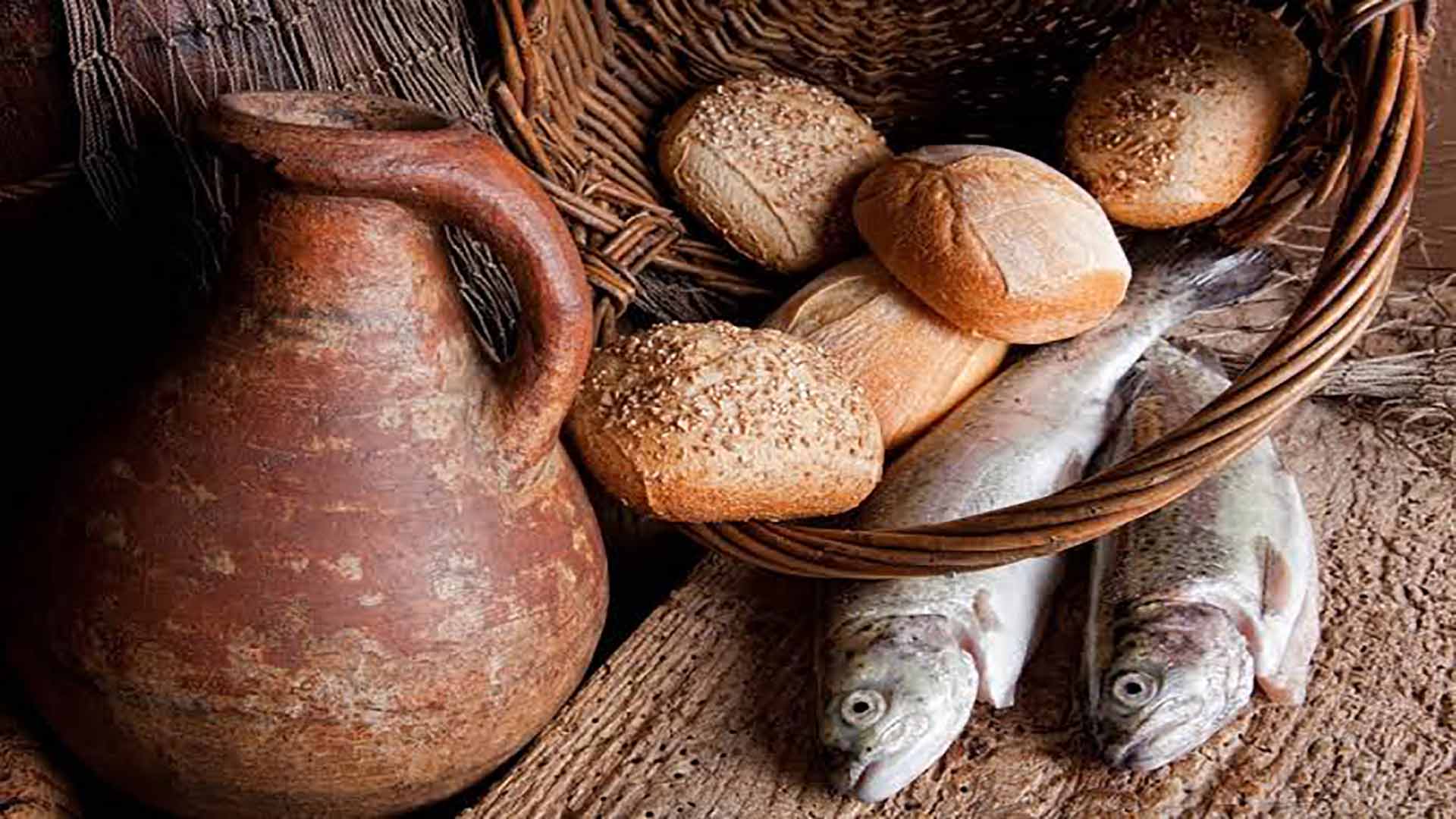
But then, like the disciples who said, ‘Five loaves and two fish are all we have here,’ we too complain that we don’t have much, don’t we? Instead, why not simply fall back on God, who is our Provider and Physician? Jesus teaches us a lesson in how to ask God, in how to pray. As the Gospel says, ‘Looking up to heaven, He said the blessing, broke the loaves, and gave them to the disciples, who in turn gave them to the crowds.’
Beyond the act of satisfying physical hunger, Jesus provided a powerful prefigurement of the Holy Eucharist by performing the exact actions of taking, blessing, breaking, and giving the loaves. It is not a symbol but a reality, not just a remembrance but true sustenance. Several saints and mystics have subsisted entirely on the Holy Eucharist without other food or drink.[1] That’s because God's grace is never scarce; it is a superabundant gift.
St Paul in the Second Reading (Rom 8:35, 37-39) says that nothing should separate us from the love of Christ — neither anguish, nor distress, persecution, famine, nakedness, peril, or the sword — simply nothing! On the contrary, ‘in all these things, we conquer overwhelmingly through Him who loved us.’
In fact, we can safely say that those who have God have everything; those without Him, even if they have everything else, have nothing. In God alone, we live a whole life.
[1] It is a phenomenon called inedia, mystical fasting, examples of which are St Catherine of Siena (1347-1380), an Italian Catholic mystic and diplomat; St Nicolau of Flue (1417-1487), a Swiss hermit and ascetic who is the patron saint of Switzerland; Servant of God Teresa Neumann (1898-1962), a German Catholic mystic and stigmatist; Venerable Marthe Robin (1902-1981), a French Roman Catholic mystic and stigmatist and founder of the Foyers de Charité association; and Blessed Alexandrina Maria da Costa (1904-1955), a Portuguese mystic and victim soul.
A timeless mandó reborn
https://www.youtube.com/watch?v=b806zc2yM_g
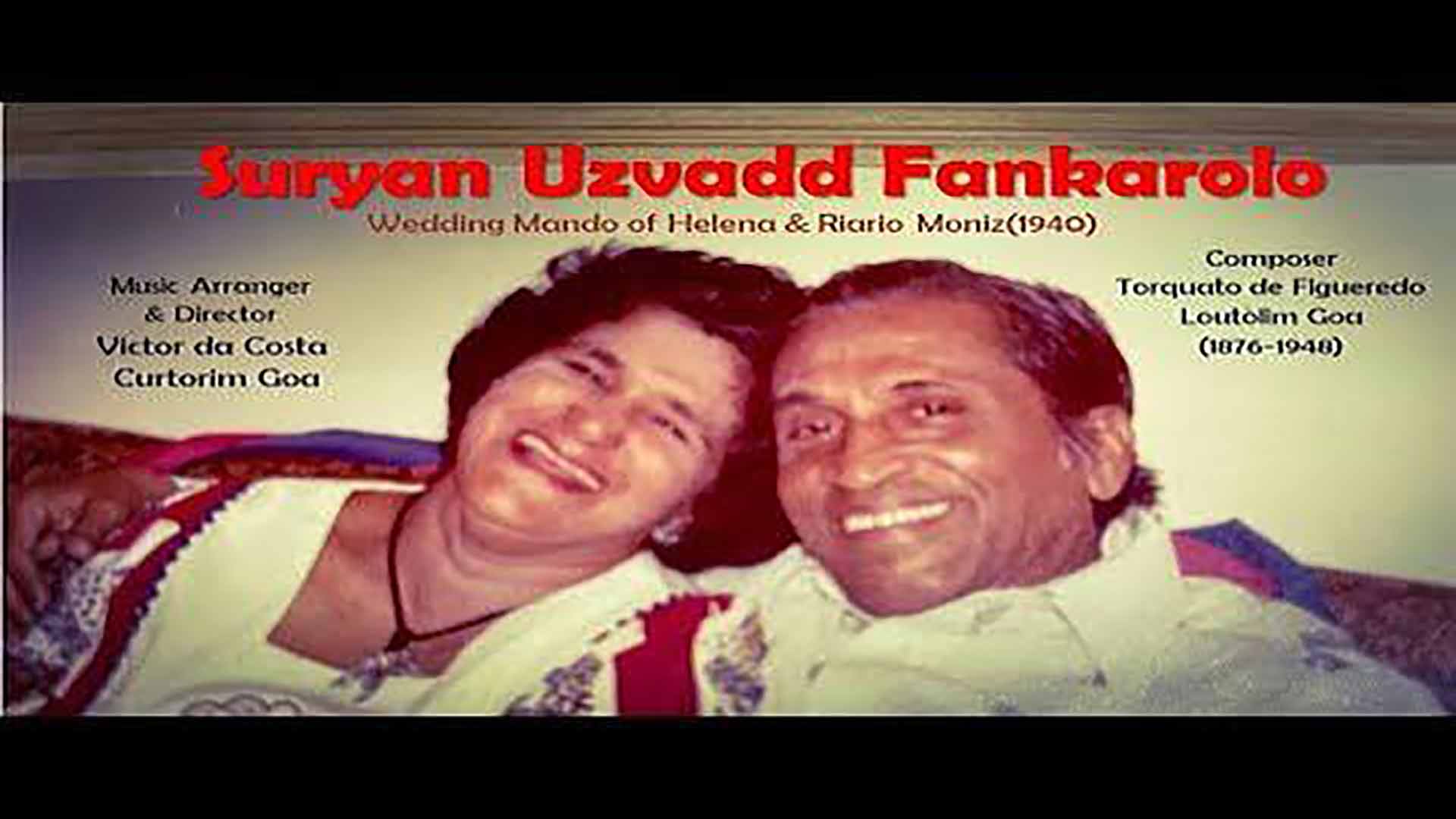
The recent production of ‘Suryan Uzvarh Fankarolo’ is a masterclass in honouring heritage. Its musical pedigree, the legacy of love it represents, and the cinematic modernisation of tradition make it truly special.
The mandó’s lyrics and music are the work of Torquato de Figueiredo (Loutulim, 1876-1948), recognised as one of Goa’s three major mandó composers, alongside Arnaldo de Menezes and Gizelino Rebelo. This particular gem was composed for the wedding of Riário Moniz (Curtorim) and Helena Quadros (Margão), held on 20 April 1940. The composition was perhaps at the cusp of the decline of the mandó tradition.
The initiative taken by the Moniz family to produce ‘Suryan Uzvarh Fankarolo’ nearly a century after its maiden live performance speaks volumes of the bond between generations. The backstory is deeply touching: as family elders met to arrange the match, the bride’s mother passed away, followed soon after by the uncle who had brokered the union. Despite this immense loss, the marriage went ahead three months later. Figueiredo, known for creating personalised wedding mandós, ensured that the raw emotion of the occasion was captured. He did so by working directly, as was his custom, with those involved—in this instance, Dr. Roque Menezes and Abelardo Valadares.
The third curiosity is the 8:22 minute video itself—arranged, performed, and directed by multi-instrumentalist Victor da Costa (Curtorim). The layered orchestral arrangements, while seeking to balance tradition and innovation in this mandó, provide an almost cinematic quality to the music. The vocal team—siblings Ivana de Delfino Pereira (Soprano) and Natasha de Delfino Pereira (Alto), supported by Siddharth Cota and Victor da Costa—aptly melodise the heartache. Considering that the lyrics in Konkani follow the dialectal orthography employed by Dr. José Pereira in his co-edited book, Song of Goa: Crown of Mandós, it is quite a challenge to be singing a haunting melody in a dialect geographically and temporally not your own.
Recorded and mixed by Andrew Ferrão of 3doors Music Studio, Verna, the audio is paired with sepia-toned visuals of family history, creating a nostalgic experience that brings the original 1940 moment to life. The video includes a poignant a cappella theme composed by Fr. António da Costa, a US-based musicologist who also translated the lyrics of the mandó into Portuguese (see Box) and is the uncle of Victor da Costa.
Beyond preserving the original composition, this project is a significant artistic contribution emanating from Curtorim, the cradle of the mandó. It is a blend of history, sorrow, love, and high-quality production.
(First published in Revista da Casa de Goa, Series II, No. 41, pp 65-66)
Called to evangelise
In modern times, we are often baffled by secular viewpoints that conflict with traditional biblical teachings. We often feel that our deeply held beliefs are out of step with mainstream culture. Some people feel psychological and social pressure to conform to norms and abandon religious practices, or at the very least, there is a loss of religious literacy. We get less and less familiar with Christian teachings and move through our days on autopilot.
It is not so with God. He has worked relentlessly for the salvation of humankind since the beginning of time. That is what we see in the First Reading (Ex 19: 2-6). We see how God freed the Hebrews from Egyptian bondage. He had a soft spot for them; they were a chosen race, a royal priesthood, a people set apart to proclaim His message to the pagan world.
For their part, the Hebrews tried to be faithful to their covenant with God and to listen to His Word. However, they gradually fell by the wayside and turned against Him. When God finally sent His only Son into the world, they put Him to the test and crucified Him. By then, Jesus had already chosen His apostles, whom He then sent to the world on a mission. Ad Gentes.
And what a mission that was! It was not a usual mission, and it continues into our days: the divine invitation extends to us as well. As Our Lord says in the Gospel (Mt 9: 36 – 10: 8): ‘The harvest indeed is great, but the labourers are few. Pray ye therefore the Lord of the harvest, that He send forth labourers into His harvest…. And having called His twelve disciples together, He gave them power over unclean spirits, to cast them out, and to heal all manner of diseases, and all manner of infirmities.’
The power to heal and cast out spirits that Jesus gave the Twelve is the same grace channelled through the Sacraments today. These visible, outward signs instituted by Christ are a way to convey divine grace, sanctify us as believers, and nourish our spiritual life. But alas, technological living very often stifles the life of the spirit; it goes against the supernatural aspects of our faith, such as miracles, or even the foundational Resurrection of Jesus, which are often rationalised, demystified, and distorted.
If we only accepted that our great God gives true and complete meaning to life, we would have consciously and happily adopted a supernatural approach to it; we would have realised that our life goes beyond the present world right into eternity. That is what we are called to do and be. Therefore, the greatest challenge before us is to be evangelically correct, not politically correct.
Jesus declared to Pilate, ‘My kingdom is not of this world.’ He prayed for his followers, stating that they are ‘in the world, but not of the world’ (Jn 17: 11-16). St Paul the Apostle echoed this by commanding them to ‘not be conformed to this world, but be transformed by the renewing of your mind’ (Rom 12: 2).
God’s command to us all to go out into the world and preach the Good News will be fruitful if we believe deeply in it. Believing is not just an act of the mind but a movement of the heart; it is not merely listening to God’s Word but acting on it with love. As followers of Christ, we need to do whatever we can, wherever we may be.
Thanks to the Good Shepherd, we are no longer sheep without a shepherd; we ought not to be on autopilot. But then, we are often the ones who fall by the wayside today. That is when we must think of our great and wonderful God who, as St Paul points out in the Second Reading (Rom 5: 6-11) reconciled Himself to us even when we turned against Him. He died to give us life; now, we have the privilege of living for Him.
To proclaim God’s Holy Name from the rooftops is our vocation and our mission as Christians: we are called to evangelise, and the undeniable fact is that our hearts will be restless until they rest in God.
Mário, intrinsic to Indian art history
You may also watch this on my YouTube channel https://www.youtube.com/watch?v=XnLJlzixsA0&t=12s
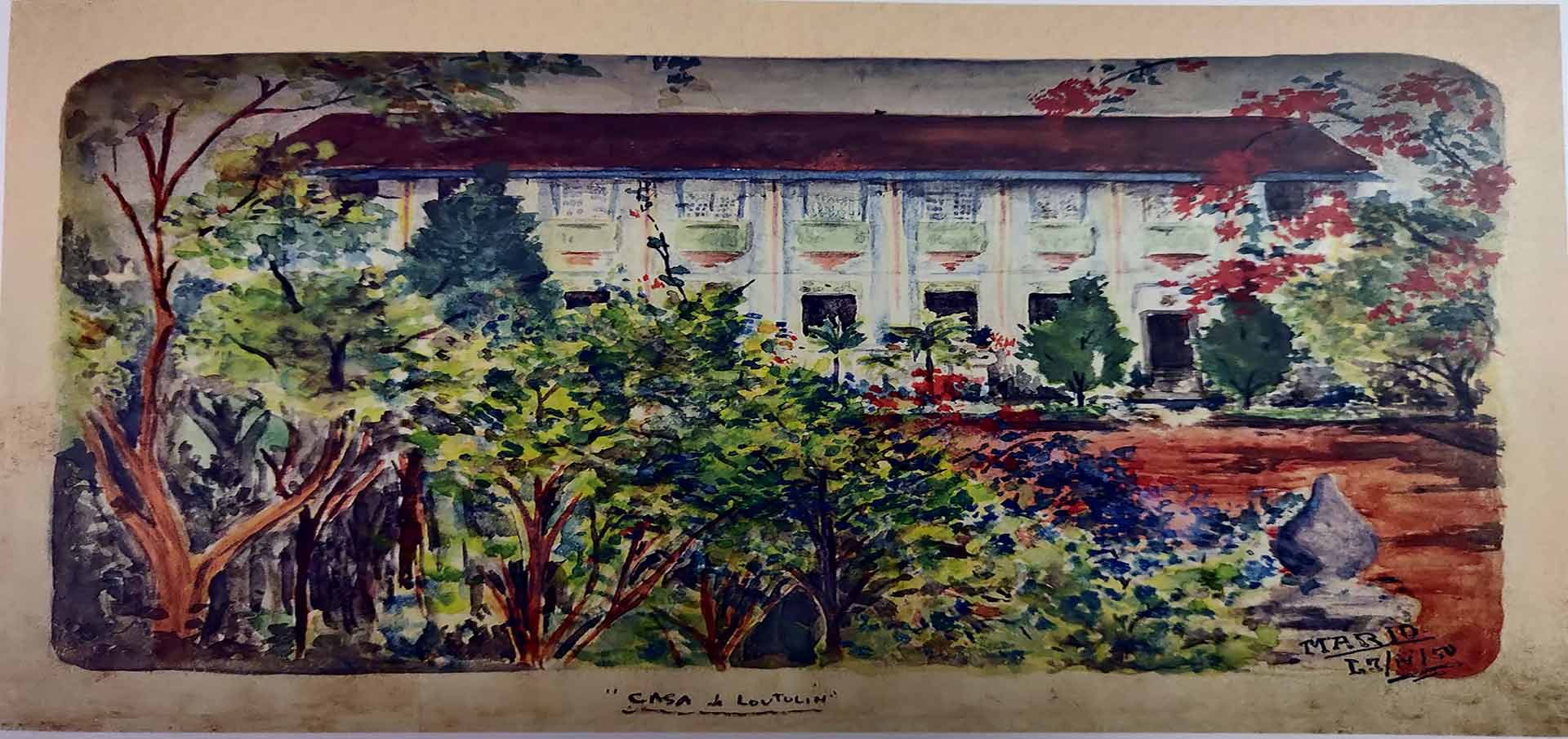
Óscar de Noronha (ON): Could you tell us something about what you worked on for your PhD, which is perhaps the first one on Mário de Miranda?
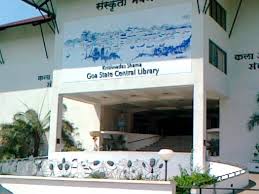
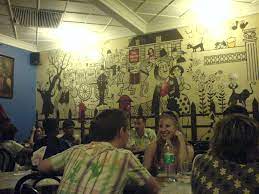
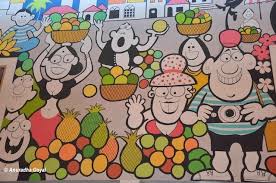
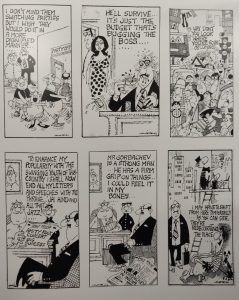
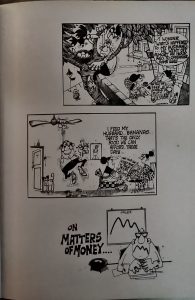
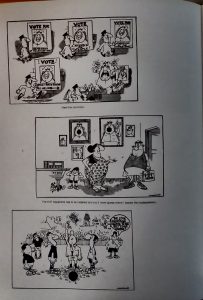
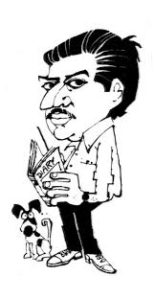
Prakruti Ramesh (PR): In my doctoral research, I tried to understand why some of the images created by the artist Mário Miranda were used, beginning in the 1980s and continuing till today, as a form of public art in Goa. You find Mario’s work displayed in government-controlled spaces like the airport, railway stations, municipal markets, the state library, and government cultural centres, but you also find his work in privately-controlled spaces, like restaurants, hotels, shopping malls, and institutes of higher learning. So, I was interested in why these pictures seem to appeal to diverse sets of people in Goa and what they communicate about the region’s history and present. What I did was basically to treat the images as a symptom of longer ranging historical processes pertaining both to Goan experiences of colonialism and to its experience of postcolonial development.
ON: Can Mário Miranda’s work be interpreted as sexist today?
PR: I would say that any form of creative expression can give rise to multiple interpretations. When social scientists like myself study cultural artifacts, what we try to do is to analyse them as evidence of social relations that prevail in a given place, at a given time. Mario’s artistic work offers clues both about the artist’s own disposition, that is, Mario’s individual biography, and about the broader political, economic, and social forces that shaped both the artist and his art.
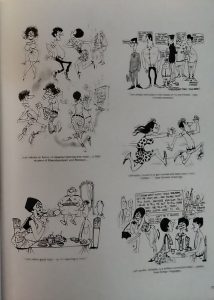
Mario’s work can certainly be analysed along the lines of gender, but they can also be analysed along other lines of stratification, like class or caste. In connection with gender, I think it’s true that quite a few of his images reproduce stereotypes about women, but these stereotypes need to be understood in relation to discourses and representations that did not originate in the mind of Mario Miranda but were in fact widely disseminated across a range of media in the twentieth century.
I think it is necessary to understand that Mario Miranda wasn’t producing his art in a vacuum. To some extent, he was following implicit or explicit directions given to him by his employers, and his employers were in turn influenced by their perception of the audience that they were catering to. They were also influenced by the professional culture of the print media at that time.
So, for me, the question is not really that of determining whether some of the pictures that Mario Miranda created were objectionable by today’s standards. What I find more interesting is, firstly, what do these images tell us about the time and place in which they were created, and secondly, what processes unfolding today have led to the retrieval of some of these images that he created, in the context of public art and city beautification. Which images are these and how do they relate to the rest of Mario’s work which does not get comparable attention.
And finally, every time an image from the past is extracted from its original context and used in the present, I think it’s interesting to ask how the image itself has changed and what new meanings are given to it by the circumstances of its display.

ON: Is there an anthropological dimension to Mário Miranda’s diaries?
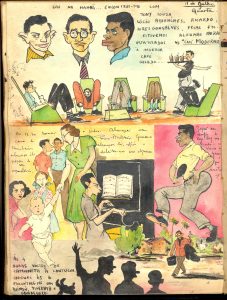
PR: I think the argument can certainly be made that the diaries of Mario Miranda which are currently accessible in English have an ethnographic component. Mario was documenting his day-to-day life with great regularity and with a high attention to detail. The form of these diaries is also extremely innovative because he blended written text with a variety of images, including cartoons, sketches, watercolour paintings, and even the occasional photograph.
But I personally would probably stop short of calling Mario an anthropologist, partly because he never claimed to be one, but also because an anthropologist’s craft includes a commitment to systematic and scientific documentation to the extent possible, of course, and Mario Miranda’s diaries are, clearly, highly subjective portrayals of his society.
But refraining from calling Mario an anthropologist does not in any way diminish the value of his work. The diaries remain very interesting historical resources with which to understand late-colonial Goa.
ON: Is Mário’s legacy yet to be recognised?
PR: One of the things that I noticed quite early into my research is that Mario Miranda has by and large been left out of recent scholarship about the history of cartooning and caricature in India. I’m not sure why this is so, but I suspect that it is because such scholarship has tended to focus on political cartoonists in India, and Mario tends to be grouped under the category of social cartoonists.
I hope that when my work is published it will correct for this omission in academic scholarship, but besides this lacuna which exists in the academic world, I think that even in Goa Mario’s artistic output tends to be very selectively celebrated. Some sections of his oeuvre have received extraordinary publicity while other sections remain neglected. And I think the selective nature of this memorial process is not a reflection of the quality of those sections of Mario’s oeuvre that are currently forgotten; rather, it reflects the values and priorities of those of us doing the remembering.
(First published in Revista da Casa de Goa, Series II, No. 40, May-June 2026, pp 42-45)
Nova visão sobre arquitectura e urbanismo português e dinamarquês na Índia
Diu, Tranquebar e Serampore
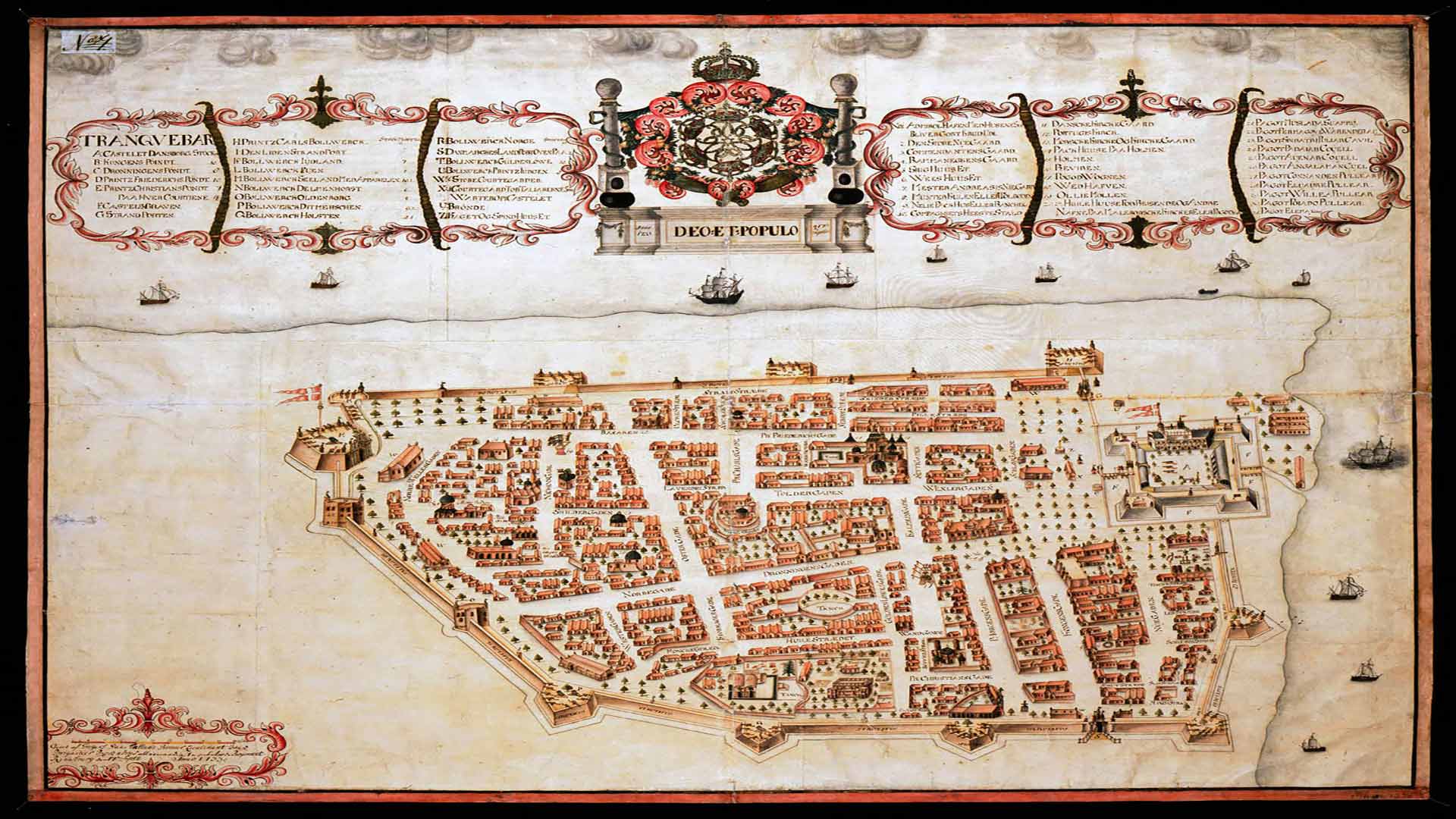
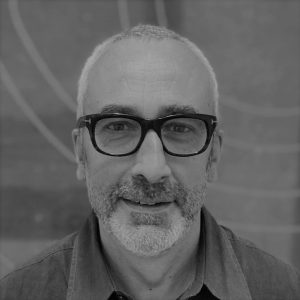
Óscar de Noronha (ON): Quando «reafirma» Diu como uma cidade colonial portuguesa — pois «nunca houve um lugar como Diu na história da presença colonial europeia na Índia» — o que é que faz desta cidade um caso de estudo tão excepcional? Acha comparável o caso de Goa ao de Diu?
Nuno Grancho (NG): Diu é excecional porque não pode ser lida como uma simples réplica da “cidade europeia” transplantada para a Índia. O que encontramos em Diu é uma situação histórica e espacial muito singular: uma soberania estratificada, uma longa duração colonial atravessada por interdependências locais e uma relação muito particular entre arquitectura, urbanismo, representação e poder. É precisamente essa combinação, entre presença portuguesa, proximidade do Islão, agência gujarati, formas católicas e culturas materiais transnacionais, que faz de Diu um laboratório privilegiado para pensar a cidade colonial para além dos modelos binários habituais “ocidental/não ocidental”. É por isso que digo que Diu obriga a rever pressupostos historiográficos muito consolidados.
Quanto a Goa, diria que é comparável apenas parcialmente. Goa é, sem dúvida, o lugar de eleição e de maior relevância para compreender a experiência colonial portuguesa na Índia e a sua cultura material, seja a arquitectura seja o urbanismo (como diria o nosso querido Paulo Varela Gomes). Mas a sua escala, centralidade administrativa e história urbana são muito diferentes das de Diu; por isso, embora haja pontos de contacto, Diu obriga-nos a rever categorias específicas que Goa, pela própria amplitude, tende, por vezes, a estabilizar.
ON: De que forma a cultura teria moldado as práticas coloniais dos portugueses em Goa, Damão e Diu e as dos dinamarqueses em Tranquebar e Serampore?
NG: A cultura moldou essas práticas de modo decisivo, porque o colonialismo nunca foi apenas um sistema político ou militar: foi também uma forma de tradução, adaptação e negociação. Em Goa, Damão e Diu, a presença portuguesa articulou-se com tradições locais, materiais, usos sociais e repertórios religiosos que produziram soluções híbridas, nem totalmente europeias nem simplesmente “indígenas”.
No caso colonial dinamarquês, em Tranquebar, no Tamil Nadu, e em Serampore, em Bengala, a escala mais limitada do seu projecto colonial (que nem sequer foi imperial, ao contrário do caso português) e a dependência de mediações locais também geraram formas específicas de negociação cultural, visíveis na arquitectura, nos modos de habitar e nas relações entre o espaço doméstico, a missão, o comércio e a administração.
Em ambos os casos, a cultura não é um pano de fundo: é uma força ativa que condiciona a forma colonial e, ao mesmo tempo, expõe os limites do poder imperial. Em ambas as presenças coloniais, a arquitectura e o urbanismo resultam sempre de contacto, tradução e acomodação, e não apenas de dominação.
A privacidade
ON: No seu livro A History of Privacy in Danish and Indian Architecture: Urbanism of Colonialism, a ser editado ainda este ano pela Routledge, como aborda o conceito e a prática da privacidade na arquitectura colonial dinamarquesa e portuguesa na Índia?
NG: No meu próximo livro A History of Privacy in Danish and Indian Architecture: Urbanism of Colonialism, a privacidade é tratada não como uma categoria universal e estável, mas como uma construção histórica, espacial e relacional. Interessa-me perceber como a arquitectura e o urbanismo produzem privacidade. Isto é, graus de retirada, separação, visibilidade e acesso, e como esses dispositivos variam entre contextos metropolitanos e coloniais em arquitectura e urbanismo.
No caso colonial dinamarquês, analiso sobretudo a forma como a privacidade se articula com a habitação, com a organização do interior doméstico, com a cultura arquitectónica e com a cultura urbana em ambiente colonial, mostrando que a distinção entre público e privado é sempre negociada e nunca puramente formal.
Mesmo quando comparo com o universo português, o meu foco está sempre na lógica dinamarquesa, mas, em ambos os casos, a questão central é a mesma: como é que a arquitectura organiza relações sociais, hierarquias e limites do corpo no espaço?
ON: De que maneira continuam as histórias coloniais da privacidade a influenciar as concepções contemporâneas de habitação urbana na Índia?
NG: Essas histórias coloniais da privacidade permanecem presentes porque muitos dos modelos contemporâneos de habitar ainda pressupõem e reproduzem dicotomias herdadas do período colonial: entre família e rua, interior e exterior, intimidade e exposição, segurança e acesso. Tais categorias não desapareceram com a descolonização. Apenas, foram reconfiguradas e continuam a informar o urbanismo, a legislação, o imaginário urbano e o imaginário arquitectónico.
Na Índia contemporânea, isso torna-se visível tanto em soluções voltadas às classes privilegiadas quanto em políticas de ordenamento do território que privilegiam certas formas de domesticidade e marginalizam outras. A história colonial da privacidade ajuda-nos, portanto, a perceber que a habitação não é apenas um problema técnico, mas também uma gramática social e política. O interesse crítico está em mostrar que o “privado” urbano moderno tem uma genealogia e que essa genealogia inclui relações coloniais de poder, exclusão e disciplina espacial.
Presença portuguesa
ON: Como poderia a camada arquitectónica indo-portuguesa de Bombaim dos séculos XVI a XVIII inspirar um planeamento urbano mais sustentável e socialmente resiliente?
NG: A camada portuguesa de Bombaim mostra que a cidade pode ser pensada como um processo acumulativo, adaptativo e relacional, e não apenas como produto de ruptura. Essa arquitectura ensina-nos o valor da adaptação climática, do uso inteligente de materiais locais, da porosidade espacial e da negociação entre as escalas domésticas, comunitárias e urbanas.
Num tempo em que a sustentabilidade é frequentemente reduzida à tecnologia, a lição mais importante poderá ser outra: a de que a resiliência urbana depende também de sociabilidades densas, de formas de vizinhança e de soluções arquitectónicas capazes de responder a múltiplos contextos. Nesse sentido e parafraseando Rahul Mehrotra, uma grande influência há muito tempo no meu trabalho, Bombaim oferece um repertório histórico útil para pensar um urbanismo menos homogéneo e mais atento à diversidade de usos, ritmos e pertenças.
ON: Na qualidade de professor visitante na Universidade de Brown, no semestre da primavera de 2027, como pretende abordar o tema «Espaços de contacto: arquitectura, colonialismo e descolonização no mundo de língua portuguesa»?
NG: Pretendo abordar o tema a partir de uma perspectiva comparativa e descentrada, tomando a arquitectura e o urbanismo como lentes para ler o colonialismo, a pós-colonialidade e a decolonização no mundo lusófono. O curso será estruturado em torno de casos e debates que cruzam Portugal, Brasil, África e Ásia, de modo a mostrar como os espaços de contacto produzem simultaneamente dominação, negociação e resistência.
A ideia é trabalhar a história da arquitectura e do urbanismo não como um campo fechado, mas como um espaço de interrogação sobre raça, migração, género, extração, memória e agência subalterna.
Na Universidade de Brown, quero também estimular os alunos a leituras cruzadas entre arquitectura, história cultural e estudos pós-coloniais, sublinhando que escrever sobre espaço implica sempre escrever sobre poder.
Perda e ganho
ON: O pensamento decolonial na Índia em geral e em Goa, Damão e Diu em particular não conduzirá afinal à perda do património colonial arquitectónico e urbano? Como equilibrar esses dois aspectos?
NG: Não creio que o pensamento decolonial implique uma “perda” do património colonial arquitectónico e do património colonial urbano. O que faz é deslocar a pergunta e o foco da análise: em vez de tratar o património colonial arquitectónico e o património colonial urbano como valores intocáveis, convida-nos a perguntar quais memórias preservam, quais violências ocultam e quem beneficia da sua consagração.
Equilibrar estes aspetos significa preservar criticamente, isto é, conservar os objectos, as formas, a arquitectura e as cidades sem tornar naturais e incontestáveis as hierarquias históricas que os produziram.
A verdadeira questão não é entre destruir e manter, mas entre celebrar sem mediação e interpretar com rigor. Uma abordagem decolonial permite, precisamente, proteger o património colonial arquitectónico e o património colonial urbano enquanto o reinscreve numa história mais justa e plural.
ON: Tendo em conta as complexidades do estudo da Ásia pós-colonial, que conselho daria aos jovens investigadores que desejem seguir uma carreira académica?
NG: Diria, antes de mais, que desenvolvam uma sólida base interdisciplinar: história, teoria, análise de desenho, leitura de fontes, trabalho de arquivo, trabalho de campo no sentido etnográfico e arquitectónico e, sempre que possível, conhecimento das línguas relevantes para o estudo. A investigação sobre a Ásia pós-colonial exige precisão conceptual e sensibilidade histórica, pois os objectos de estudo são quase sempre sobrepostos, contestados e carregados de cargas políticas.
Também aconselharia paciência intelectual e humildade metodológica. É importante evitar explicações demasiado rápidas e categorias demasiado rígidas; muitas vezes, o mais produtivo é aceitar a complexidade e trabalhar com ela.
Por fim, diria que vale a pena escolher temas que realmente exijam tempo, comparação e contraste, e atenção ao detalhe — “o diabo está nos detalhes” — porque é aí que a investigação académica ganha densidade, originalidade e relevância.
(Publicado na Revista da Casa de Goa, Serie II, No. 40, pp 46-51)
Dalgado, Konknnicho Martir ani Sant
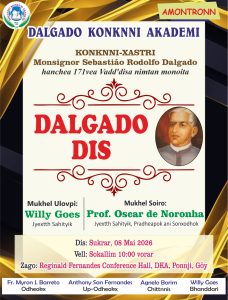
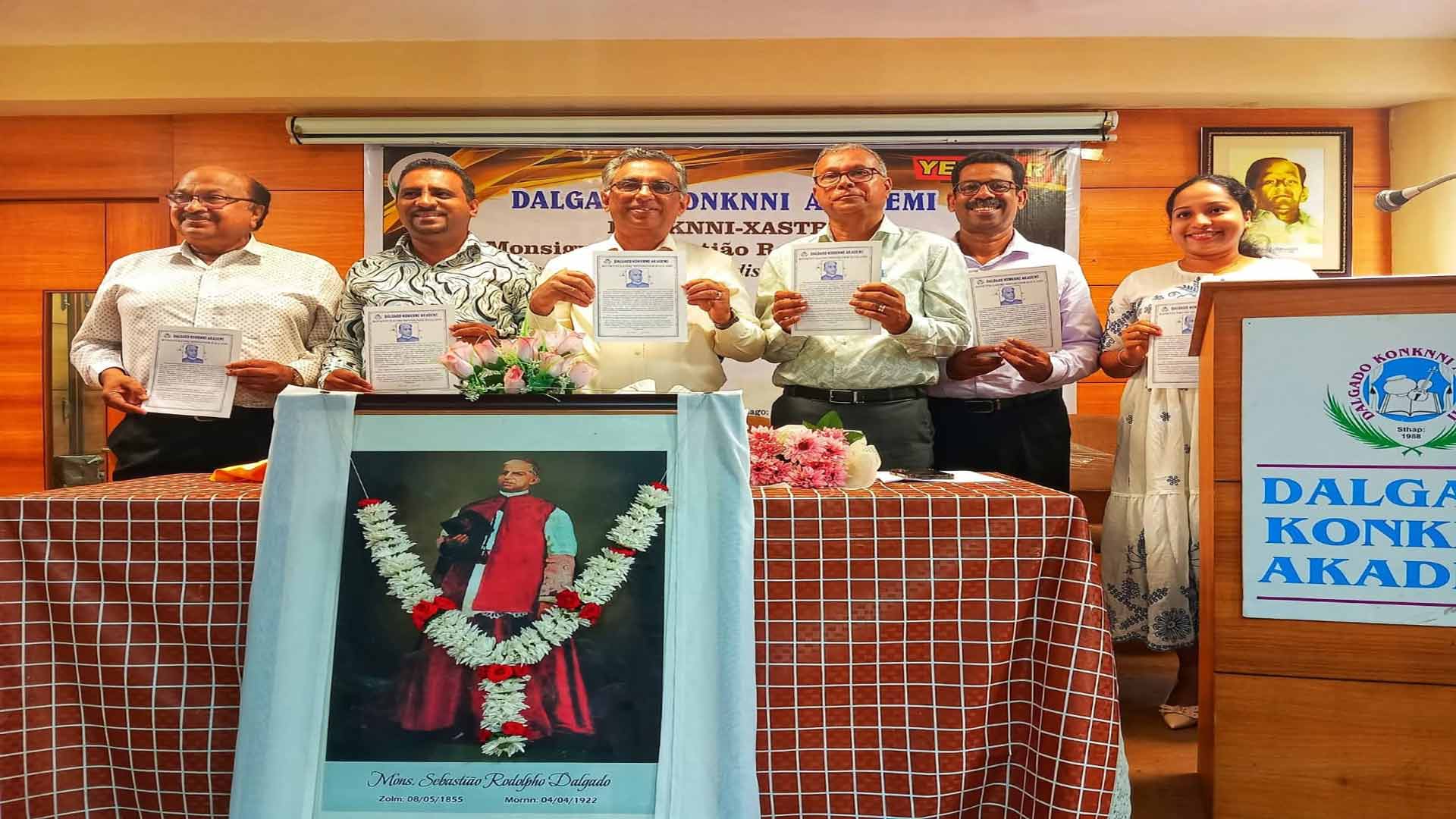
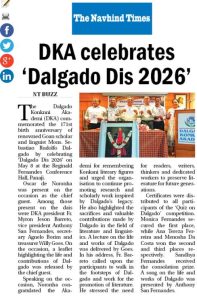
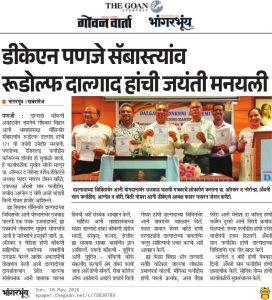
Konknni Xastri Monsenhor Sebastião Rodolfo Dalgado-hachea 171vea zolm vorsuki ugddasa somoyar mhaka mukhel soiro koso apoilo mhunn Akademi-cho Odheokx Fr Myron Barreto-haka ani somitik Deu borem korum mhonntam. Ho dis urben ani dhinvasnneche monan monoitat mhunn, soglleam vangddeank porbim.
Xabaski mhojea ixttak, aichem mukhel ulovp korpi, Willy Goes-babak, zannem umedin Monsenhor Dalgado-hachem jivit amchea mukhar dovorlem. Willy-bab ek boro kolakar, sahityakar, ani somajik vavr korpi. 2014 vorsa ami Commemorating Christ in Goa, hem pustok uzvaddaunk vangdda kam’ kelam. Tache kodden kam’ korpak sodanch khoxi bhogta.
Mhotvachem mhollear, Akademiche spordhent vantto ghetloleank hanv hun’hunit porbim ditam. Tumchi urba chalu dovorchi ani fuddlem paul marchem mhunn magtam. Akademiche karyanim vantto gheuncho. Veg-vegllea spordhent bhag gheuncho ani, bhov korun, masikant tumchem borop zaunchem. Zoitivontank ani spordhent vantto ghetla titleankui porbim ani Devachem bensanv.
Az ami zomleanv Monsenhor Dalgadacho zolm disacho ugddas monoupak. Te mhaka kiteak avoddttat tem thoddea utramnim tumkam sangunk sodtam.
Monsenhor Dalgado, ek misionar, Katolk dhormancho ani Konknni bhaxecho. Te zaite vaurle, ani diabet zaun tache paim katorle, to wheelchair-ar ani hantrunar url’lo, punn sonvsarak Konknnichi bori khobor porgottlie xivai raunk nam. Te Sanskrut zannar, ani ti zannvai tannem Konknniche sevek vaporli. To ek prodhyapak zaun-ui, ivory tower-acher ravunk nam. Te Orientalist ani zaite bhaxeche zannkar: tem xikop tannem sodanch Konknni khatir kelem ani tichem nanv fankoilem.
Mhojea ispan, Monsenhor Dalgado Konknnicho martir, Konknnicho sant. Kiteak? Konknnichi beporva zatali tednam, Konknichem vaitt ulounnem zatalem tednam, Konknnicher viruddh vetale tednam, konn ube zale? Je konn Lisboa xarant, wheelchair-acher asle te. Monsenhor Dalgado sogllem nittayer ghalunk te ube zale; Konknni rakhunk fuddem sorle.
Zoxem heam disamni ‘enough is enough’ ho naro famad zala, toxench 1917 hea vorsa, Monsenhor Dalgadan apnnachea monan ‘enough is enough’ mhunnon, Heraldo-hea disalleacher ek lekhmall boroilo, ‘O concani não é dialecto do marata’, mhonnge, Konknni Morathi-chi boli nhoi. Tannem kitem mhollem ani koxem mhollem tem bore bhaxen aikat – Portugezint boroilam tem hanvem Inglezint onnkar kelam:
“This time my only goal was to break a lance for ‘my lady’ and to avenge the wild invectives that cowardly hands threw at her, mercilessly and with iron fists, but also – sorry to say! – with neither knowledge nor conscience.”
Konnachich porti zap zali na. Panch vorsam uprant te ontorle. Tednam, tache vangddi ube zale, dekhik Professor Mariano Saldanha, zo Monsenhor Dalgado-hache Lisboa vishvavidyaloian xis asle. 1929-hea vorsa, Monsenhor Dalgado-hachi suvat bhorunk Portugez sorkaran Professor Saldanha-k apoilo, zo Ponnje Liceu-ant Sanskrut xikoitalo. Dalgado ani Saldanha, bapui ani put koxe. Ani natu? Ami natu mhunn somzun, Konknni familichem nanv voir kaddum-ia.
Professor Saldanha Romi lipiecho adhari; desache zaite zannar, zoxe Suniti Kumar Chatterjee, Babu Govind Das hannim, ani dusreachim nanvam kaddun, hi lipi Bharotacheo bhaso koxe toren vaprunk zata tem tannim spoxttponnim dakhoilem.
Tankam mog aslo toso amkam aslear, amim dubhava vinn fuddem pavtolim. Aiz poreant, soyi pormonnem cholun, ami Portugez xikleanv, ani aiz Inglez xiktanv, ani kenna-kenna Konknni visortanv. Konknni amchi mãi khori, punn ami tichi porva korunk nam. Aiz kall, ticho valor, tichem mol, novie pillgek dakhounk favo. Ti amkam koxi lagu zata, vo relevant asa, tem dakhounk favo. Atamchi ani fuddarachi poristithi polleun kam’ korunk favo.
Halinch, zo Akademin Inglez-Konknni sobdkox uzvaddaila to ekdom’ gorjecho aslo. Porbim! Vegim-vegim Konknni-Inglez kox toiar kelear borem. Tiech borobor, Romi lipi vegim-vegim promanbod’d korunk zai, vigneanik utravoll toiar korunk zai, ani sahityachem kam’ (borovop ani onnkarop) fuddem kaddunk zai. Ani ami kortanv titlem lokak dehan ani bud’dhi vixin mello sarkem zanvchem. Chodd korun, ami amche bhaxecho mog korunk favo. Love conquers all.
Mhojim don utram sompoumche poilim, ani ek pavtt tumkam xabaski ani, mhaka apoilo mhunn, Dalgado Konknni Akademik dhinvastam.
Colóquio sobre Camões realizado em Goa | Meet on Camões held in Goa
Em 12 de março, realizou-se o III Congresso do Meio Milénio do Nascimento de Luís de Camões, na Universidade de Goa. Organizado pelo Departamento de Português e a Rede Camões na Ásia e África (RCAA), teve como coordenadores o Professor Filipe de Saavedra, que é o principal responsável pela RCAA; as professoras Loraine Alberto e Irene Silveira; Delfim Correia da Silva, director do Instituto Camões em Goa; Aneri Thakkar da Comunidade Luso-descendente de Damão, e Elias Colaço da Comunidade Indo-Portuguesa de Macau.
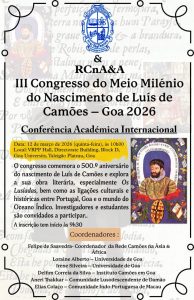
Deu as boas vindas a Professora Anuradha Wagle. Foi orador da abertura o Professor Saavedra, que, entre outras coisas, fez uma chamada para o número 2 da Revista de Estudos Camonianos publicada pela RCAA, https://plataforma9.com/publicacoes/revista-estudos-camonianos-chamada-aberta-para-o-numero-2-2026.htm. O número inicial saiu em dezembro de 2025, com autores de cinco países e regiões, incluindo Goa.
Na primeira sessão, falaram Loraine Alberto, Irene Silveira e dois alunos de mestrado, Aren Noronha e Dhruvan Nair. A segunda realizou-se no Instituto Camões, em Pangim, onde está aberta uma exposição intitulada «Os Rostos de Camões», com participação de 8 artistas goeses: Francis de Sousa, Nishant Saldanha, Sávia Viegas, Shailesh Dabholkar, Viraj Naik, Vitesh Naik, Verodina Ferrão e Yolanda de Sousa Kammermeier. Falaram os professores Wang Yuan de Pequim e Danny Susanto de Jakarta.
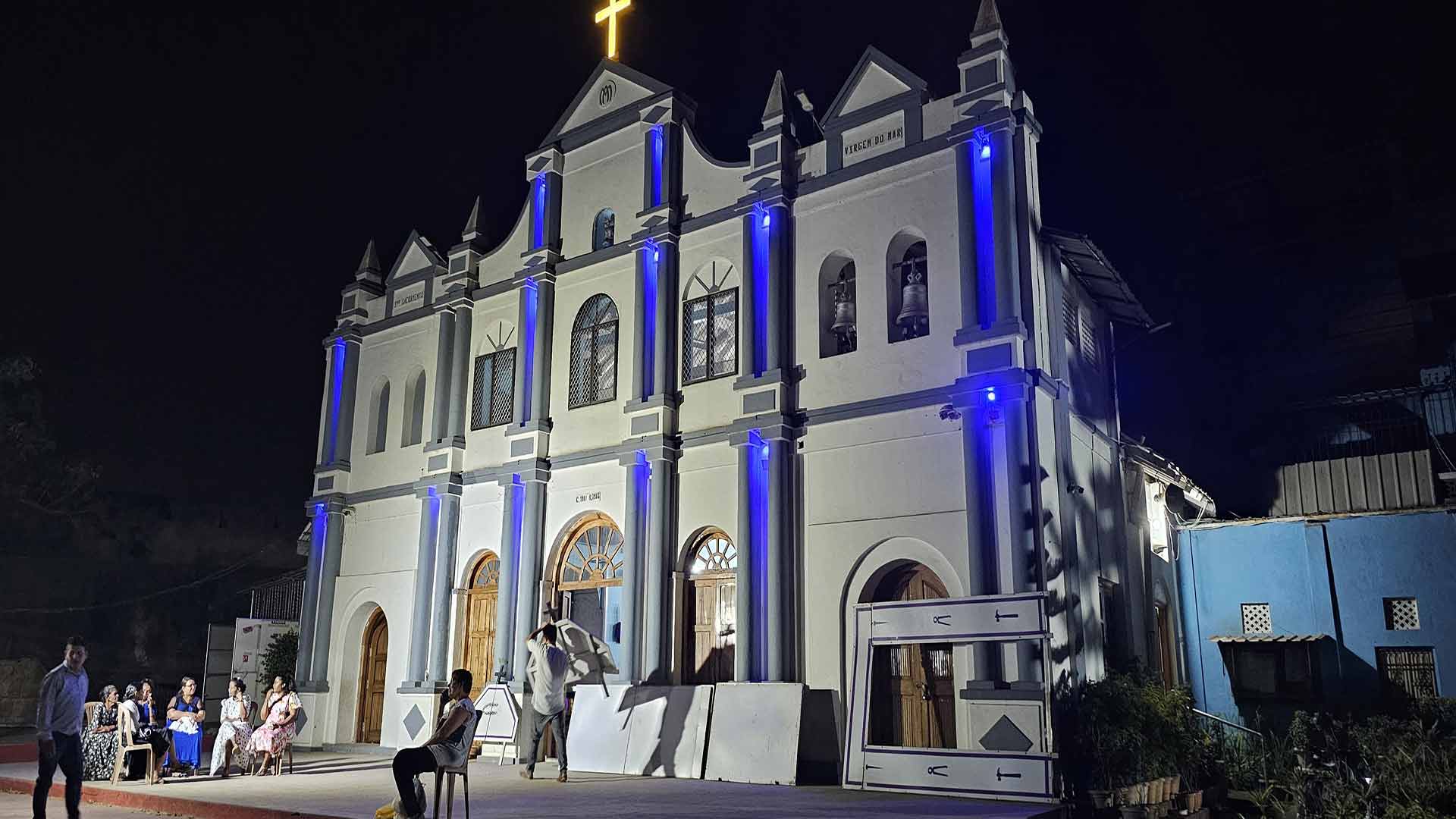
Depois de conhecer o bairro das Fontaínhas em Pangim; as igrejas e monumentos da Velha Cidade; os fortes de Aguada, Reis Magos e Tiracol; os mercados de Mapuçá e Anjuna; o seminário de Rachol e casas senhoriais, nomeadamente a dos Figueiredos de Loutulim, os conferencistas estrangeiros deslocaram-se até Damão, onde visitaram os fortes portugueses, as igrejas do Bom Jesus e de N. S. do Mar; as capelas de S. António, do Rosário e da Conceição; a casa onde viveu o Poeta Bocage, e a Câmara Municipal, que também guarda testemunhos da administração portuguesa.
O Professor Saavedra comoveu-se, muito particularmente, com a capela de Santo António na estrada de mesmo nome, em Damão Grande, e com a visita a uma família católica indo-portuguesa, onde almoçaram e cantaram. Em suas palavras: «Foi uma romagem de grande saudade e nostalgia».
(Publicado Revista da Casa de Goa, Série II, No. 40, maio-junho de 2026, pp 76-77)
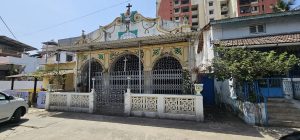
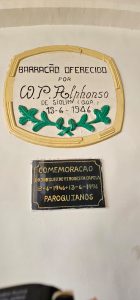
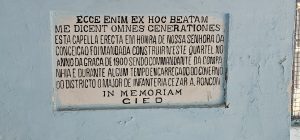
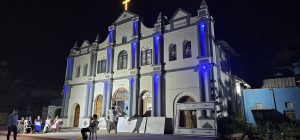
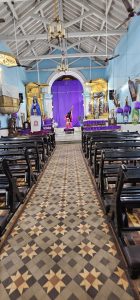
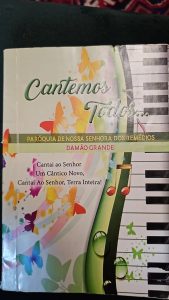
Capela de S. António e Igreja de Nossa Senhora do Mar (Fotos: Cortesia do Professor Filipe de Saavedra)
On 12 March, the Third Congress marking the 500th anniversary of the birth of Luís de Camões took place at Goa University. Organised by the Department of Portuguese and the Camões Network in Asia and Africa (Rede Camões na Ásia e África, RCAA), it was coordinated by Professor Filipe de Saavedra, who is the head of the Network; teaching faculty Loraine Alberto and Irene Silveira; Delfim Correia da Silva, director, Camões Institute, Goa; Aneri Thakkar of the Damão Community of Portuguese Descent; and Elias Colaço of the Indo-Portuguese Community of Macao.
Professor Anuradha Wagle welcomed the gathering. Professor Saavedra was the key-note speaker and, amongst other things, called for submissions for Issue 2 of the Revista de Estudos Camonianos published by the RCAA, https://plataforma9.com/publicacoes/revista-estudos-camonianos-chamada-aberta-para-o-numero-2-2026.htm. The inaugural issue was published in December 2025, featuring authors from five countries and regions, including Goa.
In the first session, Loraine Alberto, Irene Silveira and two postgraduate students, Aren Noronha and Dhruvan Nair, read papers. The second session took place at the Camões Institute in Panjim, where an exhibition entitled ‘The Faces of Camões’ is currently on display, featuring eight artists from Goa: Francis de Sousa, Nishant Saldanha, Savia Viegas, Shailesh Dabholkar, Viraj Naik, Vitesh Naik, Verodina Ferrão and Yolanda de Sousa Kammermeier. Professor Wang Yuan from Beijing and Professor Danny Susanto from Jakarta presented papers.
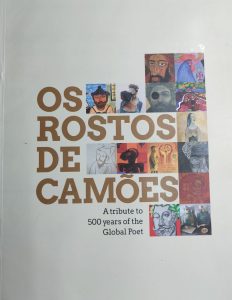
After exploring the Fontaínhas neighbourhood in Panjim; churches and monuments of Old Goa; the forts of Aguada, Reis Magos and Tiracol; markets in Mapuçá and Anjuna; Rachol Seminary, and stately homes, notably that of the Figueiredos, Loutulim, the foreign delegates travelled to Daman, where they visited the Portuguese forts, the churches of Bom Jesus and Nossa Senhora do Mar; the chapels of St Anthony, the Rosary, and the Immaculate Conception; the house where the poet Bocage lived, and the Town Hall, which also bears witness to the Portuguese presence.
Professor Saavedra was particularly moved by the chapel of Santo António on the road of the same name in Damão Grande, and by the visit to an Indo-Portuguese Catholic family, where they had lunch and sang. In his words: ‘It was a pilgrimage filled with deep longing and nostalgia’.
(First published in Revista da Casa de Goa, Series II, No. 40, May-June 2026, pp 76-77)